
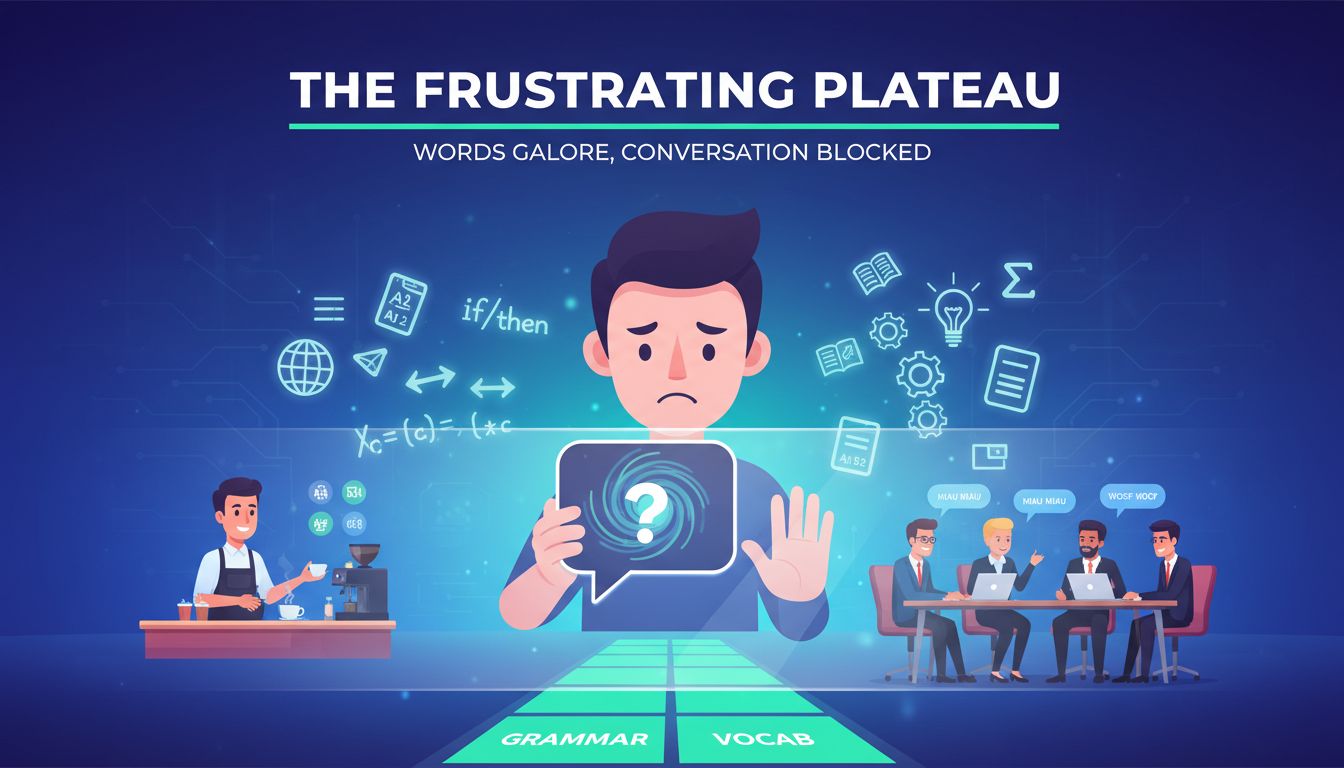
The Frustrating Plateau of Language Learning
Many language learners reach a point where they have mastered thousands of vocabulary words and can navigate complex grammar exercises with ease, yet they freeze the moment they need to order a coffee or participate in a business meeting in their target language. This gap between theoretical knowledge and practical application is often referred to as the fluency plateau. Traditional methods, while excellent for building a foundation, frequently fail to prepare students for the unpredictable, fast-paced nature of real-world conversation. The transition from a student who understands the language to a speaker who lives it requires a shift in strategy. It is no longer about how many flashcards you have reviewed; it is about how many meaningful interactions you have navigated.
The Science Behind Conversational Fluency
Fluency is not merely the accumulation of data; it is a cognitive reflex. When you speak your native language, your brain does not manually conjugate verbs or consciously select syntax. Instead, it relies on procedural memory. To reach this level in a second language, you must move beyond declarative learning (facts and rules) and engage in active production. Science suggests that the brain requires high-frequency, low-stakes practice to build the neural pathways necessary for spontaneous speech. This is where the concept of comprehensible output comes into play. By being forced to produce language in response to a stimulus, the brain is conditioned to retrieve information faster, eventually closing the gap between thought and speech.
The Passive Learning Trap
Many popular language apps focus on passive recognition. Choosing the correct translation from a multiple-choice list or dragging words into the correct order stimulates the brain’s recognition centers, but not its production centers. This creates a false sense of security. You feel like you are progressing because your score is high, but without the pressure of a real-time dialogue, your ability to construct original sentences remains underdeveloped. Scenaria addresses this by removing the safety net of multiple-choice answers, requiring users to engage their vocal muscles and cognitive retrieval processes simultaneously.
Overcoming Social Anxiety in Language Learning
One of the biggest hurdles to fluency is the affective filter—a psychological barrier involving anxiety, self-doubt, and the fear of looking foolish. When this filter is high, it blocks the brain from processing input and producing output. For many, talking to a native speaker is terrifying. AI conversations provide a safe, judgment-free laboratory where learners can experiment, fail, and try again. By practicing with an intelligent agent that doesn’t get frustrated or impatient, users can lower their affective filter, build confidence, and prepare for the social pressures of real-world interaction.
How AI Scenarios Bridge the Gap to Mastery
The innovation behind Scenaria lies in its ability to simulate contextual immersion. Immersion is widely recognized as the fastest way to learn a language, but not everyone has the luxury of moving to a foreign country. AI-powered conversations bring the immersion to the user. These are not static scripts; they are dynamic, evolving dialogues that adapt to the user’s input. Whether you are negotiating a contract, navigating a medical emergency, or chatting at a local bistro, the AI creates a simulated reality that demands practical language use.
The Scenaria Approach: Personalized Contextual Learning
What sets Scenaria apart is its commitment to practicality. Instead of learning abstract phrases about colors or farm animals, users are placed into scenarios that mirror their specific goals. A business traveler needs different vocabulary than a student studying abroad. By leveraging advanced AI, Scenaria tailors the complexity and the subject matter to the individual, ensuring that every minute of practice is relevant to their life. This personalized approach ensures that learners are not just memorizing words, but are acquiring the specific linguistic tools they need for their unique journey.
Dynamic Feedback Loops
Real-time correction is essential for preventing the fossilization of errors. However, constant interruption can kill the flow of a conversation. Scenaria utilizes an intelligent feedback system that analyzes your speech patterns, grammar, and pronunciation. Instead of a red ‘X’ appearing every time you make a mistake, the system provides nuanced suggestions and explanations after the dialogue has concluded, or through subtle contextual hints. This allows you to maintain the flow of conversation while still benefiting from rigorous academic oversight.
Real-World Roleplay and Situational Practice
Roleplay has long been a staple of the classroom, but its effectiveness is often limited by the proficiency levels of fellow students. In Scenaria, your roleplay partner is an AI capable of native-level complexity. You can practice ‘The Job Interview,’ ‘The First Date,’ or ‘The Apartment Viewing’ as many times as you need. Each session is different; the AI might throw a curveball question or express a different emotion, forcing you to stay on your toes and use your language skills creatively rather than robotically.
Building Cognitive Reflexes for Fast Response Times
A major component of fluency is processing speed. If you have to translate every sentence from your native language to your target language in your head, the conversation will have moved on before you can speak. Immersive AI conversations train your brain to bypass the translation phase. Through repeated exposure to common conversational structures in various contexts, these patterns become ‘chunked’ in your memory. You stop thinking about ‘Subject + Verb + Object’ and start thinking in phrases and ideas. This speed is what allows a speaker to feel truly ‘local’ and confident.
The Emotional Intelligence of AI Conversations
Modern AI is capable of more than just grammar checks; it can simulate tone and emotion. Understanding how something is said is often as important as what is said. Scenaria’s AI can detect nuances in your speech and respond with appropriate social cues. This helps learners pick up on cultural etiquette and the unspoken rules of conversation that aren’t found in textbooks. Learning to navigate these social nuances is the final step in moving from a proficient speaker to a truly fluent one.
Actionable Strategies for Maximizing Your AI Practice
To get the most out of your sessions with Scenaria, consider the following strategies:
- Set Specific Goals: Instead of general practice, decide to master one specific scenario per week, such as ‘returning an item at a store.’
- Embrace the Mistake: Use the AI’s safe environment to try complex sentences you aren’t sure of. Failure is a data point for growth.
- Speak Out Loud: Fluency involves muscle memory. Always use the voice-to-speech features to train your vocal cords and improve your accent.
- Review Your Transcripts: Analyze the feedback provided after each session to identify recurring patterns in your errors.
The Future of Global Communication
The world is becoming increasingly interconnected, and the ability to communicate across borders is no longer a luxury—it is a necessity. However, the barrier to entry has traditionally been high, requiring years of study and expensive tutors. AI technology is democratizing fluency by providing high-quality, 24/7 access to immersive practice. Scenaria is at the forefront of this revolution, proving that with the right tools, anyone can speak like a local. By focusing on conversational confidence and practical application, we are not just teaching languages; we are opening doors to new cultures, careers, and connections.
Conclusion: From Student to Speaker
Becoming fluent is not a destination you reach by finishing a textbook; it is a state of being that you achieve through consistent, meaningful practice. If you are tired of feeling like a perpetual beginner despite your hard work, it is time to change your environment. Immersive AI conversations offer the missing link in language education, providing the intensity of immersion with the accessibility of a smartphone. With Scenaria, you can stop studying the language and start speaking it. The journey to fluency begins with a single conversation—are you ready to start yours?